The clearest way to explain the difference is to walk through how a project unfolds under each model, and then point out where the seams are. We have worked under both. The seams matter.
How The Traditional General Contractor Model Works
In the traditional model, a homeowner hires an architect first. That architect spends somewhere between four and twelve months developing schematic plans, design development drawings, and construction documents. When the drawings are nearly complete, and sometimes after they are fully complete, the homeowner sends them out to three or four general contractors for competitive bids.
The contractors review the drawings, ask their subs to price the work, add a margin, and return with a number. The homeowner picks one, usually the one whose number is closest to what they were hoping to spend, signs a contract, and construction begins. The architect stays involved for periodic site visits, but the day-to-day decisions are between the homeowner, the contractor, and the trades on site.
It is a model that works fine for projects where the design is straightforward and the budget has plenty of cushion. It is not the model we would recommend for a complex custom home or a luxury renovation.
Where The Traditional Model Breaks Down
The reason this model still exists is that it preserves competition at the bidding stage. The reason it costs homeowners money is that competition shows up far too late in the process.
By the time three contractors are pricing the drawings, the design has already locked in dozens of decisions that constrain what is possible. The framing strategy assumes a certain budget for structure. The mechanical plan assumes certain ceiling heights. The finishes are written into the specifications. If any of those assumptions does not match the contractor's reality, and they rarely do because the contractor was not in the room when the assumptions were made, the bid comes back high.
So the homeowner does one of three things: increases the budget, value-engineers the design, which often means months of redrawing, or fires the contractor and starts the bid process again. We have seen each of these scenarios cost six and seven figures in time, drawings, and momentum.
How A Design-Build Firm Is Structured Differently
In a design-build model, the design team and the construction team are the same team, or at minimum, they work as one integrated unit from the first conversation. The homeowner signs one contract with one firm that is accountable for design, planning, and construction.
What that changes, in practice:
- The builder is in the room when the architect is sketching layouts, so structure and budget are realistic constraints, not surprises.
- Selections happen in the order construction needs them, with the team that has to install them already at the table.
- When something has to change, and on projects this size something always does, the decision makers are already aligned. There is no week-long pause for the architect to redraw and the contractor to re-price.
- One firm owns the outcome. There is no opportunity to point at the other side of the table when something goes wrong.
The cost of that alignment is paid up front, in the form of a design and pre-construction phase that you can see on the invoice. The savings show up across the entire rest of the project, mostly in change orders that never get written. Our own interior design process is built to sit inside this same structure rather than alongside it.
What This Looks Like In Practice
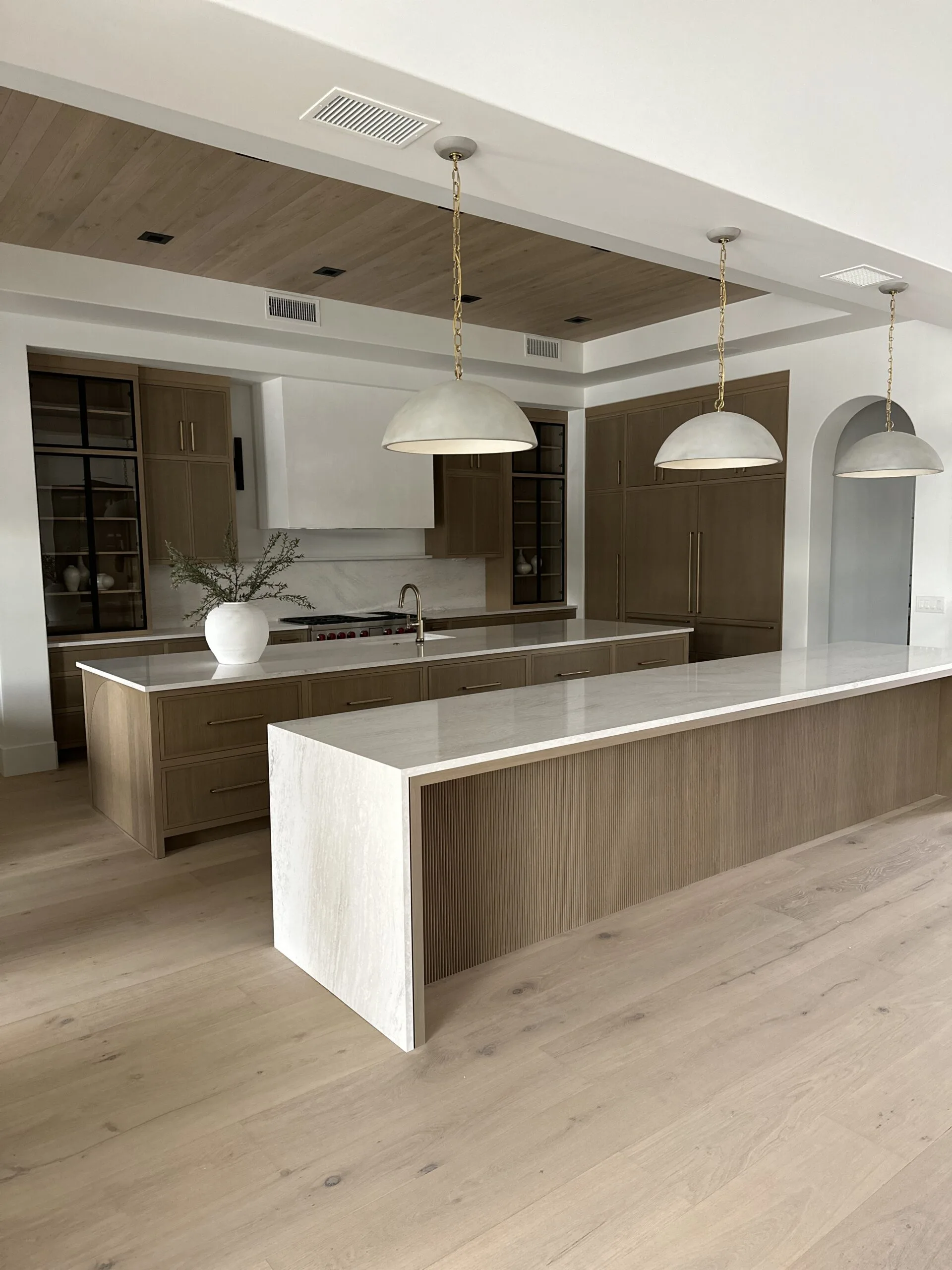
One of the clearest examples we have watched play out: a homeowner brings us drawings that were developed over two years with an architect and a designer. The plans are beautiful. The kitchen has a fourteen foot island, a ceiling detail that requires re-engineering the trusses, and a window wall that the structural engineer has not priced into the foundation.
The number to build the home as drawn comes in well over the homeowner's budget. The architect did not know that. Nobody intended to mislead anyone. But the conversation that needed to happen between budget and design happened too late, and now there is a decision: spend more, redraw, or compromise on the parts of the home that matter most.
When the team is integrated from the start, that conversation happens at month two instead of month twenty-four, and it is a productive conversation instead of a painful one.
What Homeowners Should Ask Before Signing
Before committing to either structure, it is worth asking a few direct questions. Who is accountable if the estimate and the drawings do not agree. How are changes priced and approved once construction starts. Who sits in the room during selections, and how early. The answers reveal which model a firm is running, regardless of what they call themselves.
It is also worth asking to see how a firm has handled a project that went sideways. Every project meets a surprise somewhere, whether it is a permit delay, a material shortage, or an existing condition nobody expected. The way a team responds to that moment says more about the structure than the marketing materials do.
How Change Orders Are Handled Differently
Change orders are where the two models diverge most visibly once construction is underway. In a bid-build arrangement, a change often has to travel back through the architect for a revised drawing, then back to the contractor for a revised price, then back to the homeowner for approval. Each leg of that trip costs time, and time on an active job site costs money.
In a design-build arrangement, the same change can be priced and approved in a single conversation, because the people who need to weigh in are already sitting at the same table. That does not eliminate change orders. Renovations especially will always surface conditions nobody could see before demolition. It does mean the response is faster and the number is more trustworthy, because it comes from the team that will do the work.
When A Traditional GC Is The Right Call
We will be honest: design-build is not always the answer. If you have a relationship with an architect you have worked with for years, the design is locked, the structure is straightforward, and you have a contractor you trust to deliver the drawings as is, the traditional model can work fine. Simple additions, low-complexity remodels, and projects where the homeowner has deep construction experience all tend to be reasonable fits.
The model breaks where complexity, custom design, or significant investment are in play. The bigger the project, the higher the cost of poor alignment, and the more value an integrated team delivers.
Where Provision Fits Into This Comparison
We built our process around the integrated model because it is the one that has protected our clients' budgets most consistently. Our design and construction services sit under one roof, and you can see the results of that structure across our portfolio and hear it directly from clients in our reviews.
If you would like to learn more about who is behind that process, our who we are page is a good place to start.
The Bottom Line
A general contractor is hired to build what someone else has already designed. A design-build firm is hired to deliver the entire outcome, design and construction, as a single, accountable process. For most homeowners we work with, the second one is what they want; they just did not have a name for it.
If you are early in planning a custom home or major renovation, the most important decision you will make is not which contractor to hire. It is how you want the project structured. We would rather have that conversation early than be the firm called in late to clean up the consequences of a process that did not fit. Reach out whenever you are ready to talk it through.